Case study · AI product interface development
From toxicology model to product: building DioScor’s usable front end
Consone AI had already established DioScor’s scientific foundation, predictive capability and commercial direction. The remaining challenge was product translation: turning complex, layered toxicology output into a credible front-end experience that scientific users, partners and prospective buyers could understand, interrogate and evaluate. Veda designed and developed that interface around Consone AI’s requirements and subject-matter expertise.
- Client
- Consone AI
- Product
- DioScor
- Engagement
- Front-end product translation, interface design and development
- Status
- Front-end delivery complete; awaiting go-live
01
A strong scientific foundation needed a usable product layer
Consone AI had already assembled curated toxicity data from human and animal studies, developed the deep-learning capability behind organism-level predictions, and defined where DioScor should sit as a product. The model and proposition were not the missing pieces.
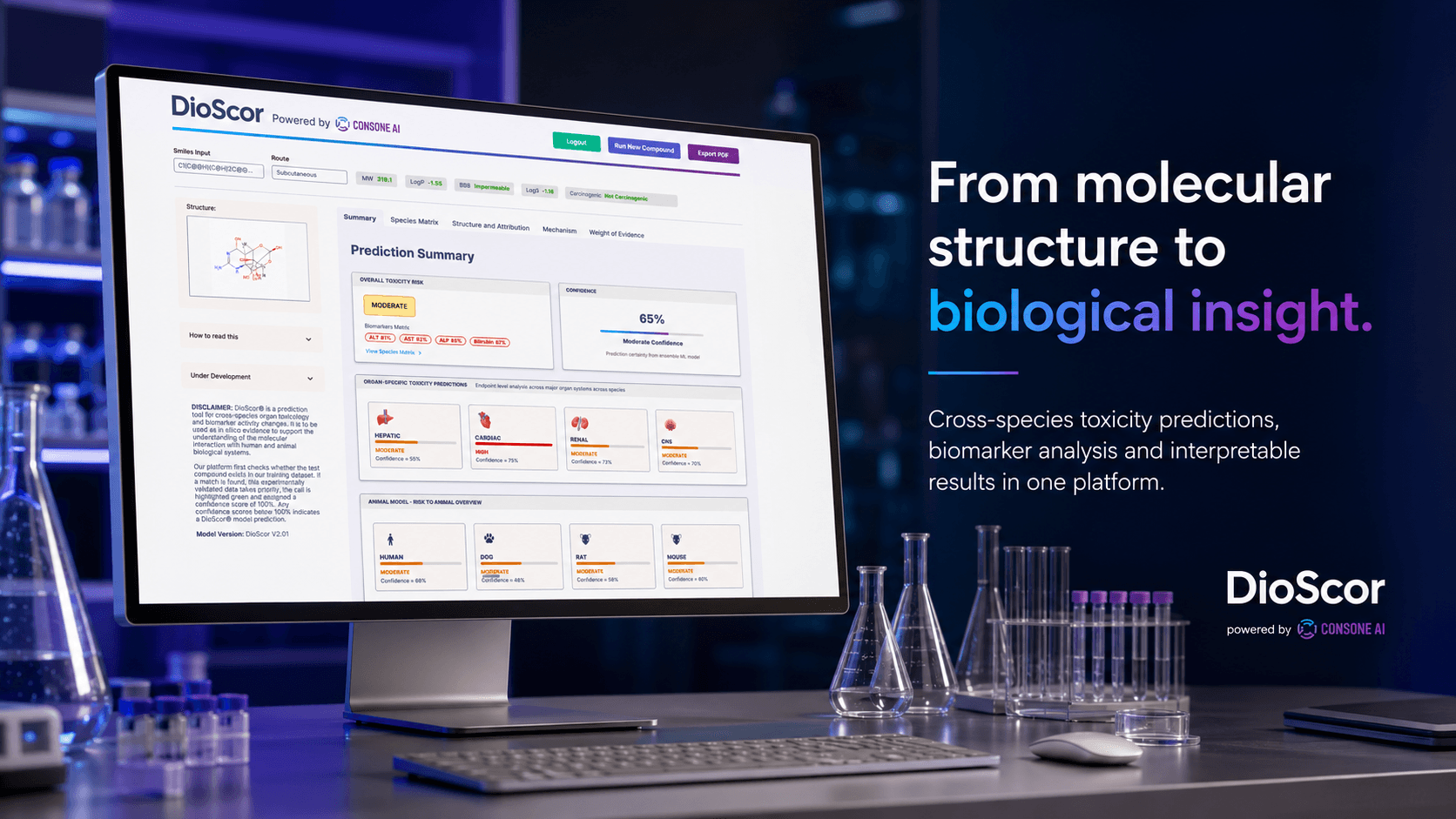
What remained was the software surface through which somebody could submit a compound, understand the result, inspect confidence and supporting evidence, and move through a coherent reporting journey without losing the scientific nuance underneath it.
02
The interface had to organise complex model output
A scientific AI interface cannot stop at presenting a prediction. DioScor needed to communicate cross-species and organ-level findings, confidence, structural attribution, biomarkers, mechanisms and known evidence without collapsing them into a false single answer.
The product also needed to distinguish curated source data from model output and keep the limits of prediction visible. DioScor supports interpretation; it does not replace regulatory testing or guarantee that a compound is safe.
- Layered interpretation — summary first, with confidence and supporting detail available for inspection
- Clear evidence boundaries — known compound evidence and model predictions remain visibly distinct
- Responsible product language — uncertainty and the limits of prediction stay present in the experience
03
Product requirements became a structured user journey
Veda translated Consone AI’s product direction and subject-matter expertise into the front-end architecture: the information model, interaction flow, visual hierarchy and responsive implementation needed to make the capability usable.
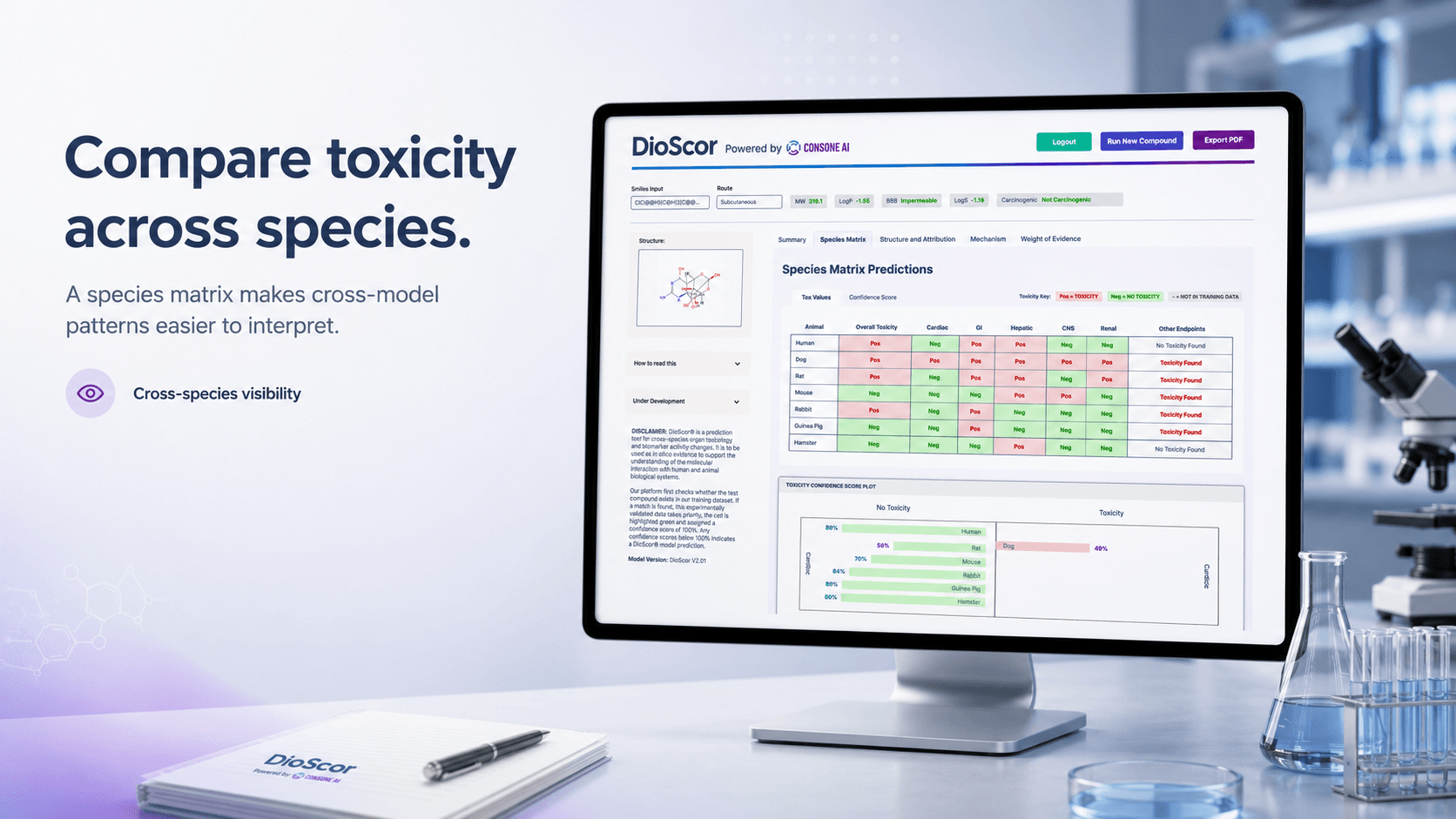
The resulting journey moves from molecular input and exposure route through prediction summary, cross-species comparison, structural and mechanistic interpretation, weight of evidence and exportable reporting.
- Interface architecture — complex scientific information ordered around the decisions a user needs to make
- Explainability presentation — confidence, attribution, mechanisms and evidence designed as product layers
- Responsive front-end delivery — the defined experience implemented for demonstration, review and launch
04
Explainability became part of the interface architecture
DioScor’s interface is deliberately layered. A user can begin with the prediction summary and confidence, then move into organ-level risk, species comparison, molecular regions, biomarker pathways, mechanisms and similar compounds as more scrutiny is required.
That structure makes technical depth available without placing every result at the same visual level. It also treats explainability as a core interaction requirement rather than a disclaimer attached after the prediction.

05
Evidence is available for review, not decoration
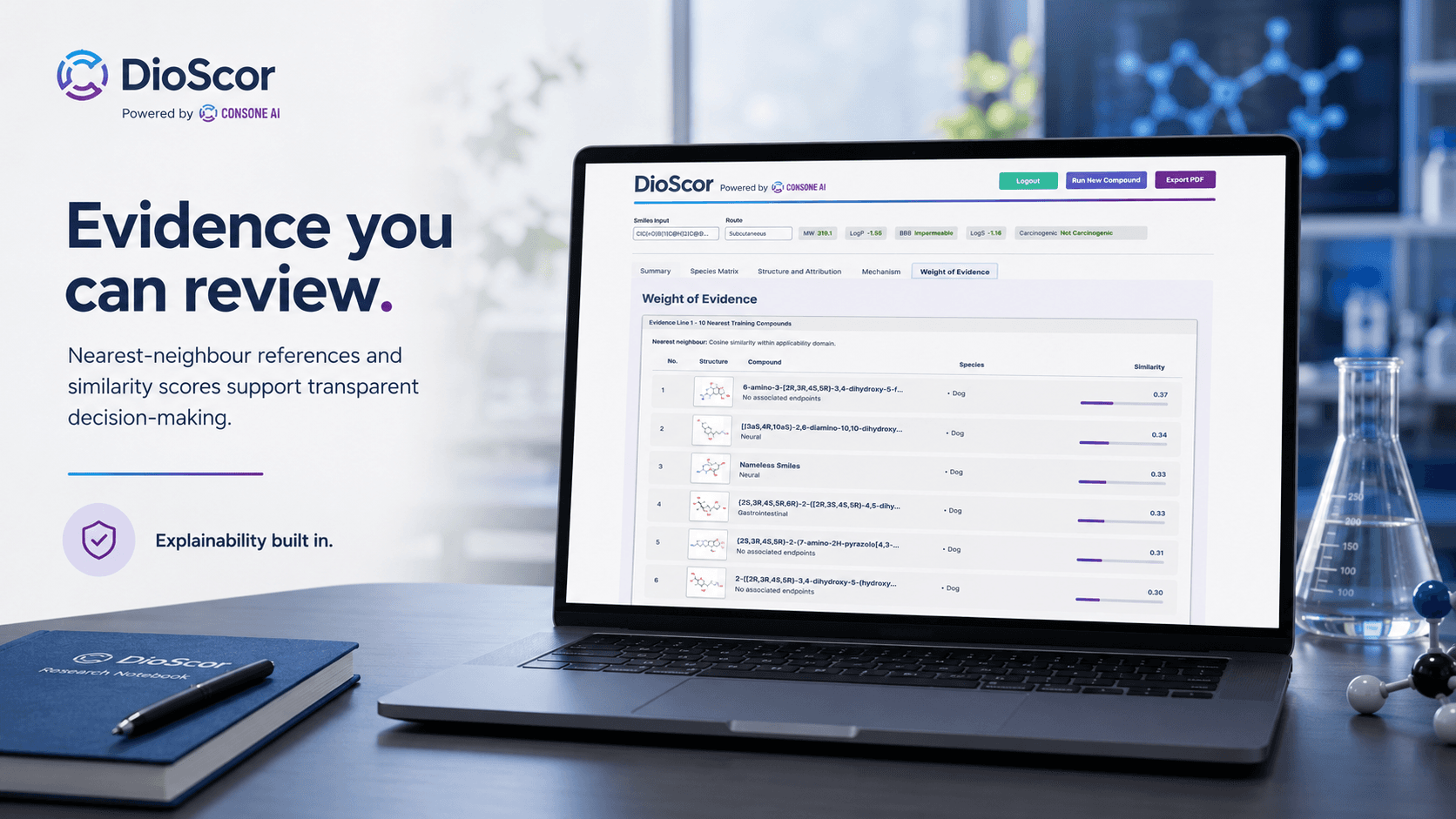
The weight-of-evidence view places a result alongside known compounds, molecular similarities, relevant species, endpoints and applicability information. Instead of asking a user to accept an isolated score, the product gives them a route into the material that supports interpretation.
That is especially important in scientific software: trust comes from showing how a result can be examined, where its confidence comes from and which questions remain outside the model’s scope.
06
A delivered front end with claims kept in bounds
Consone AI supplied the science, predictive model and product direction. Veda’s role was to turn those defined requirements into a structured, visual and reportable front-end experience, then deliver the responsive interface needed for demonstration, review and launch.
Front-end delivery is complete and the product is awaiting go-live. Until live evidence exists, this case study does not claim adoption, commercial performance or scientific outcomes. The proof is the product translation and implementation itself.
What this proves
Complex AI needs a front end people can understand and interrogate
DioScor demonstrates how defined scientific requirements and model outputs can become a responsible product experience without overstating the interface team’s role in the underlying science, strategy or evidence.
- Scientific requirements translated into one coherent front-end journey
- Complex model output made layered and available for inspection
- Uncertainty and evidence treated as core interface requirements
- Product design and responsive implementation delivered together
Have a defined AI product that needs a credible front end?
If the model and product direction are clear but users still need a way to understand, inspect and act on the output, we can turn those requirements into a responsive product interface built for demonstration, review and launch.